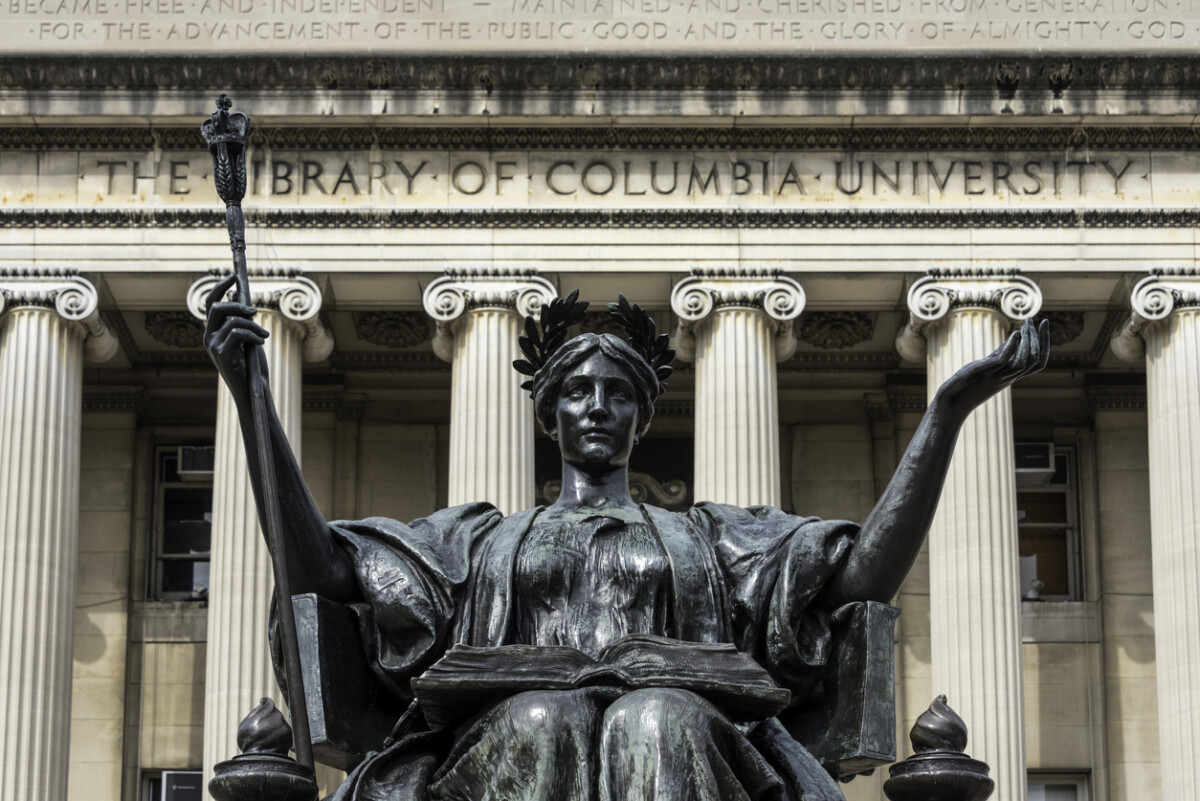
After months of negotiation, Columbia University announced on July 23 that it had reached an agreement with the Trump administration to resolve investigations into alleged violations of federal anti-discrimination laws. The settlement provides that Columbia will pay fines of $221m over three years, and that in consideration for these payments and other concessions—including concessions made by Columbia as a precondition to the negotiations —the Trump administration will reinstate the “vast majority” of the federal grants the government paused or canceled in March. In announcing the settlement, Columbia stated that the settlement’s terms are “carefully crafted to protect the values that define us.” In Columbia’s telling, the settlement “preserves Columbia’s autonomy and authority over faculty hiring, admissions, and academic decision-making.”
We see this differently. As an initial matter, we fear that the Trump administration will view the settlement as validating its most outlandish claims about “diversity, equity, and inclusion” programs, student protests relating to Gaza, and Columbia’s response to allegations of antisemitism. To be sure, Columbia has not admitted wrongdoing—it “denies liability” in the settlement’s first paragraph. But Columbia’s acquiescence to the agreement is nonetheless likely to provide cover for the Trump administration’s ongoing, lawless assault on higher education.
We also have serious concerns about many of the settlement’s terms, as we discuss below. The settlement narrows Columbia’s autonomy with respect to admissions, the hiring and promotion of faculty, and curriculum—all aspects of what the Supreme Court has called the “essential freedoms” of the university. It imposes new rules relating to protest on campus and student discipline that should be entirely the province of the university to decide. It also supplies the Trump administration with ongoing leverage by requiring the university to satisfy nebulous contractual terms and burdensome reporting requirements under the threat of litigation if its compliance is deemed to be less than satisfactory. In addition, the settlement creates a monitoring and surveillance regime that is certain to chill the exercise of freedoms that are central to the university’s mission.
We recognize that Columbia might have made some of these commitments on its own accord, without unconstitutional coercion from the Trump administration. But even if we assume, against the evidence, that Columbia would have adopted all of these commitments on its own, the settlement is a significant surrender of autonomy because the university has ceded the right to revise these commitments during the agreement’s three-year term.
Columbia’s leaders should not have agreed to this. Still, it is easy to understand why they did. The Trump administration has already done immense damage to the university, and it was threatening to do much more. Many of the Trump administration’s actions against Columbia plainly violate the First Amendment, but litigation would have been costly, risky, and likely to involve months or years of uncertainty. Even successful litigation would not have yielded complete relief from the administration’s campaign of extortion. Indeed, successful litigation might have provoked new assaults, including further grant cancellations, the rescission of Columbia’s tax-exempt status, and even more onerous restrictions on Columbia’s ability to host students from abroad.
But all of us should be clear-eyed about the settlement’s costs. The settlement is an astonishing transfer of autonomy and authority to the government—and not just to the government, but to an administration whose disdain for the values of the academy is demonstrated anew every day. It will have far-reaching implications for free speech and academic freedom at Columbia—even if we assume that the provisions that are susceptible to more than one interpretation will be construed narrowly, as the settlement itself says they should be (¶ 5). We also doubt that the Trump administration will be satisfied with the territory it has won. The settlement does not foreclose the Trump administration from demanding more from Columbia on the basis of the university’s real or imagined failure to comply with the settlement’s terms, or on the basis of purported transgressions that are new or newly discovered. Indeed, the settlement itself gives the administration an array of new tools to use in the service of its coercive campaign.
Those of us at Columbia should understand how our university is being transformed, and those at other universities contemplating similar settlements should understand how much is at stake. We are sympathetic to Columbia’s leaders, who are operating under extraordinary pressure, but we cannot agree that the settlement “protect[s] the values that define us.”
* * *
Admissions. The July 23 settlement limits an important aspect of Columbia’s academic freedom—its freedom to decide which students should be admitted to study. First, the settlement creates ambiguity about which factors Columbia may permissibly consider in evaluating applications for admission. The Supreme Court held two years ago that race-based admissions decisions violate the Equal Protection Clause of the Fourteenth Amendment. It emphasized, however, that its decision should not be understood to bar universities from “considering an applicant’s discussion of how race affected his or her life, be it through discrimination, inspiration, or otherwise.” Some language in the settlement agreement might be read as eliminating this authority. This is particularly true of the language prohibiting the use of “personal statements, diversity narratives, or any applicant reference to racial identity as a means to introduce or justify discrimination,” and the language barring the use of “proxies for racial admission” (¶ 16). The settlement does not define these phrases, but a broad reading of them would make it difficult for Columbia to adopt admissions policies that have the effect of increasing the enrollment of underrepresented racial minorities even if the university’s purpose is to admit more first-generation college students, or more students from low-income backgrounds, or to increase diversity along some other axis. We hope the settlement’s language will be read more narrowly.
Even more troubling are the restrictions the settlement imposes on Columbia’s freedom to admit foreign students. The settlement expressly requires Columbia to “take steps to decrease financial dependence on international student enrollment” (¶ 22), which presumably means that Columbia will admit fewer foreign students in the future than it does now. This requirement is particularly significant because it threatens to change one of Columbia’s defining features. Columbia has long described itself as a “global university.” Its claim to that label turns in significant part on the large number of foreign students it enrolls, and on the role that those foreign students play in shaping every aspect of university life.
The settlement also requires Columbia to “ensure that international students are asked questions designed to elicit their reasons for wishing to study in the United States” (¶ 21). The requirement seems benign on its face, but Secretary of State Marco Rubio has said that foreign students who engage in protest are violating the terms of their visas, and the Trump administration has already revoked the visas of many students who participated in campus protests relating to Gaza. The settlement’s seemingly innocuous language gives the Trump administration a way of holding Columbia accountable for students who engage in disfavored political protest—and will likely deter Columbia from admitting those students in the first place. At a press conference, Secretary Rubio declared that “We are not going to be importing activists to the United States.” The settlement’s provisions are an effort to enlist Columbia in the enforcement of this unconstitutional policy.
Hiring, promotion, and curriculum. The July 23 settlement also limits Columbia’s authority over the hiring of faculty and administrators. It obliges Columbia to appoint new faculty members “with joint positions in both the Institute for Israel and Jewish Studies and the departments or fields of economics, political science, or [public policy]”—faculty members who will (the settlement says, without explaining) “contribute to a robust and intellectually diverse academic environment” (¶ 13). We know of no precedent for the federal government compelling a private university to hire faculty in specific fields, let alone dictating the specific institutes and departments to which they must be appointed.
The settlement also requires the university to “maintain” a Senior Vice Provost “focused on promoting excellence in regional studies” (¶ 12), which builds on a commitment made by Columbia on March 21 in response to the Trump administration’s demand that the university place the Department of Middle East, South Asian, and African Studies under “academic receivership.” Under the settlement’s terms, the Senior Vice Provost is to review the university’s “portfolio of programs in regional areas across the university, starting with the Middle East,” with the goal of ensuring that the programs’ offerings are “comprehensive and balanced.” The Senior Vice Provost is also tasked with reviewing “all aspects of [the programs’] leadership and curriculum.”
Setting aside the question of whether there are good reasons for Columbia to single out its programs relating to the Middle East for special scrutiny at this particular moment, it is disturbing that the settlement requires the university to conduct this review, dictates the scope and purpose of the review, and gives the Trump administration the power to go to court if it concludes that Columbia has not satisfied its obligations. These provisions are a profound intrusion into Columbia’s autonomy.
Protest. The settlement also imposes new constraints on Columbia’s policies relating to protest on campus. For example, it requires the university to categorically prohibit “protest activities” inside academic buildings and “places where academic activities take place.” The settlement declares that such activities “present a direct impediment to maintaining Columbia’s core academic mission,” but in fact many activities that might be understood to constitute protest activities—like leafletting, wearing expressive clothing, silently walking out of class, or even hosting a controversial lecture by an invited speaker—do not usually cause significant disruption, let alone disruption of the kind that would justify banning the activity. Especially if the term “protest activities” is interpreted expansively, the effect of the settlement will be to stifle a wide range of speech that would serve Columbia’s mission rather than compromise it.
The settlement also seems to contemplate that Columbia will suppress certain kinds of political speech on the basis of viewpoint. On this topic the settlement itself says only that “Columbia will evenly implement its institution-wide policies on harassment and discrimination under Title VI” (¶ 29)—but one of the commitments Columbia made in the lead-up to the settlement, and possibly as a precondition for it, was to interpret Title VI by reference to a controversial definition of antisemitism—advanced by the International Holocaust Remembrance Association (IHRA)—that encompasses certain speech critical of Israel, including, for example, speech that subjects Israel to a double-standard or analogizes Israel’s policies towards the Palestinians to Nazi Germany’s policies towards the Jews. We note that the IHRA stresses that its definition should be applied with due consideration of “context,” but we are concerned, as many other free speech advocates are, that using the IHRA definition to delineate the outer boundaries of free speech on campus will have a severe chilling effect on constitutionally protected speech. Scholarship, teaching, learning, and protest about Israel and Palestine already take place in a climate characterized by suspicion, fear, and arbitrary censorship. Columbia’s adoption of the IHRA definition is sure to make matters worse.
Finally, the settlement compels Columbia to make major changes to policies relating to student discipline. It bars the university from including students on panels of the University Judicial Board and requires that the university house its disciplinary apparatus in the Office of the Provost (¶ 26)—effectively sidelining the University Senate, which was created after the 1968 protests at Columbia to ensure broad participation of faculty, students, and staff in matters of university-wide concern. It also bars the university from providing UJB panel members with information about students’ immigration status, bars the UJB from considering students’ immigration status in its decisions (¶ 26), and requires the university to provide the government, “upon request,” with records relating to disciplinary actions taken against foreign students (¶ 23). This is significant because the Trump administration has already arrested and threatened to deport foreign students based on constitutionally protected speech—Columbia students among them—and has proclaimed its intention to deport foreign students who are found to have violated university rules.
University life. We are also concerned that the cumulative effect on university life of the settlement’s terms will be to subject the university’s administration, faculty, staff, and students to a regime of intensive, ongoing, official surveillance over the exercise of constitutionally protected freedoms.
The settlement establishes a “Resolution Monitor” whose role is to assess and report on Columbia’s compliance with the settlement agreement (¶ 40), and it requires Columbia to make “regular reports” to the Resolution Monitor to establish its compliance with the settlement’s terms (¶¶ 11, 45). The settlement also requires the university to publish semi-annual public reports (¶ 54). Other provisions of the settlement (some already noted above) require Columbia to provide the Resolution Monitor with comprehensive data about admissions (¶ 18) and faculty hiring and promotion (¶ 19), and require Columbia to supply the government with data about disciplinary actions taken against foreign students (¶ 23). The settlement also commits Columbia to establishing a process by which “any member of the Columbia community” can report allegations of noncompliance with the settlement’s terms to the Resolution Monitor (¶ 33). Perhaps most disturbing, the settlement requires Columbia to provide the Resolution Monitor with access to any non-privileged “documents and data relating to the Agreement that the Resolution Monitor . . . reasonably deems necessary” to carry out his duties (¶ 50), and to give the government access to “all Columbia staff, employees, facilities, documents, and data relating to the Agreement, to the extent not unreasonable” or legally privileged (¶ 51).
The cumulative effect of these terms will be, again, to subject Columbia’s administrators, faculty, and students to a regime of intense surveillance. The surveillance is a significant incursion into the university’s autonomy and will inevitably deter faculty and students in their exercise of constitutionally protected freedoms. It may also provide the Trump administration with pretexts to make new demands of the university.
* * *
Columbia has been the target of a months-long campaign of extortion by a presidential administration that is contemptuous of legal constraint and deeply hostile to the values that universities exist to promote. We are not convinced the settlement will put this behind us. What we can say with confidence is that the settlement comes at a very steep price to Columbia’s autonomy and to the constitutional freedoms of Columbia’s faculty, staff, and students. All of us affiliated with Columbia should understand this—and administrators, faculty, and students at other universities should know how much is at stake in their own institutions’ negotiations with the Trump administration. Again, we fully appreciate that the alternatives to settlement would have come with their own formidable costs and risks. It would be deeply unfortunate, however, if Columbia’s settlement were to become a model for the rest of the academy.
After it canceled $400m in grants to Columbia in March, the Trump administration demanded that Columbia take a number of steps as a “precondition” to further negotiations. The commitments Columbia made in response, on March 21, are referenced in the July 23 settlement and incorporated into it. Columbia made additional commitments on July 15 without expressly linking them to the Trump administration’s demands. Columbia’s press release announcing the settlement describes the July 23 settlement as “building on” the July 15 commitments.
Jameel Jaffer is executive director of the Knight Institute.
Alex Abdo is litigation director at the Knight Institute.
Katy Glenn Bass is research director at the Knight Institute.
Nadine Farid Johnson is policy director at the Knight Institute.
Larry Siems served for eight years as the Knight First Amendment Institute’s chief of staff, and now serves in the role of special advisor.