
Last month’s confluence of FOIA’s 60th and America’s 250th anniversaries has made amateur historians of us all. Settled histories and understandings of our legal heritage have been reopened, for better or worse, and many long-held truths find themselves in jeopardy thanks to years of erosion. FOIA’s history is no exception to this trend. The muscular transparency legislated last century has waned over years of administrative disinvestment, judicial backslide, and public complacency. A Congress preoccupied with media, a media preoccupied with spectacle, and a public disillusioned of both have left wounds in our democratic institutions to fester.
In debate to override President Ford’s veto of the 1974 FOIA amendments, Rep. John Dent (D-PA) observed that, in July 1776, our Republic was founded by a people “tired of hearing nothing from Mother England but dictums as to how to conduct their affairs and where they were to send taxes.” Now, 250 Julys later, we come back to government by imperial decrees which rebuke explanation. OMB has explicitly divested the executive branch from transparency. In its own words:
The number of FOIA requests from leftist activist groups has exploded due to Trump Derangement Syndrome and it would not be serving the American peoples’ desire for a smaller, leaner government to waste money hiring additional FOIA processors to address this bourgeoning cottage industry of political activists. In working with limited budgets, we choose to hire ICE officers instead of FOIA processors.
Of course, blaming mentally deranged leftists for FOIA’s collapse is as unfounded as “Trump Derangement Syndrome” itself. It is also (hopefully) insincere, except as an expression of political loyalty. It is also reflective of how awash we are in, to use a technical term, bullshit.
FOIA cannot seem to escape bullshit
FOIA cannot seem to escape bullshit. Supporters speak as though it provides meaningful on-demand transparency, because we believe it is worth fighting for and possible to achieve. Others find FOIA a convenient prop. FBI Director Kash Patel accused the Atlantic magazine of purposefully failing to file “a simple FOIA” before reporting that the FBI requested breaching equipment to open his hotel room when he was nonresponsive. Perhaps the Atlantic did not turn to FOIA because another request seeking similar materials was given an estimated response date of 2031. Prolific FOIA user and litigant Robert F. Kennedy Jr. became Health and Human Services Secretary on a promise of “radical transparency” and, in his first hundred days, eliminated the entire Centers for Disease Control FOIA office and most of the FOIA staff at the Food and Drug Administration and the National Institutes of Health.
Maybe FOIA has never worked. The concerns of 1974 are essentially unchanged, excepting that the conferees of the 93rd Congress had yet to learn of the Deliberative Process Privilege. Fifty-two years ago, Congress knew that “if there is a way that a law can be interpreted to promote secrecy and to deny the public access to public records, some Government officials will find that way.” FOIA was strengthened in response to the realization that, faced with an “imperial Presidency . . . . and the inherent rules and criteria-making powers of the bureaus and departments of the executive branch, Congress ha[d] become the fifth wheel on a hearse.” As Rep. Bill Alexander (D-AR) observed in urging the override of President Ford’s veto of the 1974 bill, as patriotism is the last refuge of scoundrels, so too “withholding of information from the public is the ‘last refuge’ of the bureaucrat.”
FOIA is great because it tasks agencies with opening their books to public inspection. This is also its fundamental weakness: it is administered by agencies, which are staffed by people. Those people, even where decent, public-minded, and conscientious, are dedicated to their agency’s mission. Even worse, some of those people are lawyers, specifically trained to protect their clients’ interests at all costs, and those interests do not align with disclosing agency secrets. The adversarial American legal system, the legalistic nature of government, and the threat perceived from FOIA make on-demand disclosure a fantasy. FOIA is, at best, an inconvenient unfunded mandate, if not a threat to agency mission or, even worse, a career. Some research suggests merely receiving a request can harm civil servants’ trust in the public they serve.
FOIA Processing
As a litigator, and until recently an agency FOIA processor, I will focus on what I know best: processing and exemptions. But what is processing? And why is it so difficult and expensive? Releasing a record is the easiest thing in the world. Simply attach it to an email. Hell, run off a few hundred copies and throw them off the roof, you silly goose. Processing is not about releasing records though; and it is slow and expensive by design. It is a painstaking series of redundancies taken by risk-averse FOIA offices to protect themselves from internal institutional backlash:
- Find the record
- Identify the relevant interests
- is the requester interested in this record, i.e., is it responsive?
- will release harm an interest the agency cares about?
- inquire with program office
- inquire with interested agency leadership
- is the agency legally allowed to care about that interest?
- if not, is there another plausible interest that can be asserted for the same info?
- is the agency legally required to care about any other interest?
- is someone else interested?
- refer for interagency consultation
- ask private partners if they would like it kept confidential
- is there an agency policy or custom to always redact certain kinds of information regardless of interest?
- Redact information affecting all identified interests
- Repeat step 2 & 3 twice each with your supervisor and manager
- Awareness Review!
- repeat step 2 & 3 with interested program offices
- repeat step 2 & 3 with interested leadership office
- make appropriate changes
- repeat Step 4 to address changes made in the awareness consultation
“Processing” is designed to explore every plausible alternative to release. If someone in that chain refuses or forgets to clear the release it can go on the shelf indefinitely. The process invites stakeholders from any interested office to substitute their judgment for the FOIA expert’s, with formal accountability mechanisms few and far between. If inexperienced agency leaders take the wheel and crash into litigation, the responsible FOIA office is the moral crumple zone.
Nine narrowly tailored exemptions have thus metastasized into a “veritable avalanche of FOIA related precedent” as agencies go to “great expense of litigation . . . display[ing] an attitude that could be interpreted as . . . ‘If you want this information, sue the Government’” before releasing documents under protest. From personal experience, the presumption of disclosure is a dead letter. Recommended releases are pared down by every step, and even a combative pro-disclosure FOIA officer must pick their battles carefully. More career-minded experts quickly learn management’s preferences for what kinds of information to withhold, and personal peccadilloes quickly accrete into permanent presumptions. Virtually every email address in government is withheld as a “clearly unreasonable invasion of personal privacy” under Exemptions 6, 7(C), and (at DHS) even 7(F)! (Exemption 7(F) applies where release of the information would endanger the life of a “small and specific group,” such as the “family members or coworkers of a named individual” and is not generally used for stuff like desk phone numbers and emails.)
The broad nature of the rules thus facilitate abuse, and past legislative fixes, like the foreseeable harm standard from the 2016 FOIA Improvement Act, have fallen short. It has been leveraged in litigation, but for most retail requesters, the only change is to the boilerplate: “Please know I have considered the foreseeable harm standard in making this determination.” Requesters want to be taken seriously. They turn to litigation for the same reason we jam “0” and shout “agent” at customer service phone trees: the process seems designed to frustrate you into giving up.
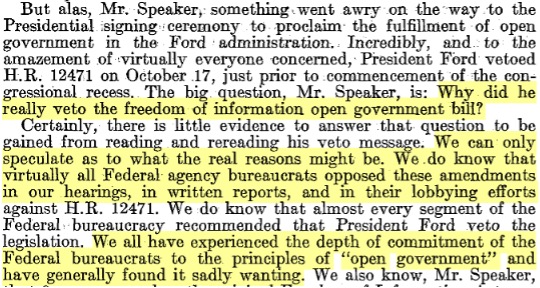
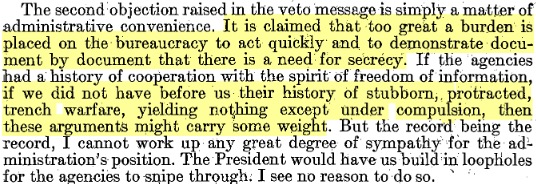
Taking requesters seriously would break administrative kayfabe: the FOIA office can’t admit they do not actually make the FOIA decisions. FOIA decisions come from agency managers, leadership, and attorneys who believe their role, understandably, is to “protect the agency.” And these days, agency managers, leadership, and attorneys aren’t acting their best. The job of the FOIA office is thus not to release records, but to generate plausible-sounding reasons for requesters and courts to believe they simply couldn’t be released. The denial is intended to persuade without regard for truth, often simply by reciting the statutory standard and claiming it applies. It is exactly Harry Frankfurt’s definition of bullshit, and it is the legacy of FOIA. President Ford even vetoed the 1974 amendments for bullshit reasons:
To my agency readers, I know very well this is not true of all agencies, FOIA offices, or especially FOIA professionals. When I say “agencies,” I’m talking about those other bad ones, not you. Most of us are doing the best we can with what we have. But laws cannot be written assuming good faith compliance.
So What?
What, then, is to be done? First, and most importantly, actually fund FOIA’s mandate. Give every FOIA office a billion dollars, sure. Second, make sure they actually use those resources on transparency, not massaging the secrecy preferences of agency leadership, by getting the extra cooks out of the kitchen.
At least for appeals, prohibit anyone involved in denying a request from being part of the appeal. I heard too many orders to deny a request on shaky grounds because “we can sort it out if they appeal” and saw appeals decided by the same staff and managers responsible for the denial (none of whose names, incidentally, appear on the release letter). Ideally, appeals would be decided by an independent body unbeholden to the agency’s parochial interests. Reps. Frank J. Horton (R-NY) and John Erlenborn’s (R-IL) proposed FOIA amendments in H.R. 4960 included the creation of an FOI Commission to resolve appeals from agency denials. Rep. Erlenborn prophesized that the coming years would demonstrate the utility of such an idea. Prof. Margaret Kwoka’s proposal for an American Information Commission carries this argument forward far better than I could. Do whatever she says there and give it a billion dollars as well.
Determination letters are among the greatest sources of FOIA bullshit, as form letters written by nobody and signed pro forma. The 93rd Congress wisely realized that bureaucrats are less likely to behave arbitrarily when “the names and positions of all government officials responsible for [FOIA denials] are required . . . to be noted in denials and reported annually to Congress.” They did not anticipate that agencies would respond by simply hiding the ball. I wrote dozens of determination letters both releasing and withholding tens of thousands of pages of records which I personally reviewed, and my name never appeared in one. Initial and appellate determinations should name anyone who even looks at a proposed response. If meddling in FOIA can’t be banned in a way that matters, it should at least require accountability. Determinations should further list the filenames or titles of any fully denied record so that requesters can know what exactly, they are even appealing.
For appeals to be effective, a requester also has to know what they are appealing and why. The designer of the checkbox form letter which lists every existing exemption that may or may not apply should be ejected from the federal service. Determinations should include a plain list of each responsive withheld record by filename and the exemption used to withhold each. Yes, this will be burdensome, but the logic of Vaughn and its progeny applies just as much to appeals as litigation. And as the D.C. Circuit explained in Mead Data Central, Inc. v. U. S. Dep't of the Air Force, 566 F.2d 242 (D.C. Cir. 1977), there is an easy alternative:
Certainly these procedures add significantly to the resource costs an agency must bear if it chooses not to disclosure [sic] material it has in good faith decided is exempt. Those burdens may be avoided at the option of the agency, however, by immediate disclosure. Congress has encouraged the agencies to disclose exempt material for which there is no compelling reason for withholding, and an agency's own balancing of the resource costs of justifying nondisclosure against the value of secrecy may provide a rough estimate of how compelling is its reason for withholding.
The interagency and intra-agency consultation process, which has developed an entire extra-legal administrative ecosystem all its own, must be subject to legislative control. Agencies should absolutely be prohibited from salami-slicing requests into their constituent atoms and assigning each to a separate processing track. Earlier this year, I reviewed a simple request for the DOJ Headquarters visitor log, maintained as a single excel spreadsheet by the Justice Management Division. JMD split the request and the record 25 ways, with 25 records, 25 processing numbers, one for each component office. Of these, 1 was responded to in full, 3 were acknowledged, 1 was delayed because the component demanded processing fees, 1 was denied in full, 12 were responded to in part, and 7 were ignored. The partial denials incorporated four different exemptions depending on the local custom of the component FOIA offices. This is madness, generates massive policy inconsistency, was borderline unappealable, and makes a mockery of the DOJ’s self-reported FOIA processing numbers. One request becomes 25 by administrative sleight-of-hand.
The judicial review provisions must be rewritten and strengthened. Decades of case law have taken FOIA far from its original intent and language to facilitate agency delay and carelessness. Agencies can and do change justifications for withholding in initial determinations, appeals, and in court. The agencies have sole access to the relevant evidence, and without extraordinary insider access or reporting, it is nearly impossible to overcome the presumption of good faith afforded their declarations. An agency which fails to justify withholdings or redactions in sworn declarations is often given two or more extra tries before a court will order in camera inspection or the records’ release. Thankfully, this trend may be reversing in some cases as judges tire of “the notion that agencies may repeatedly seek summary judgment until they eventually justify withholding relevant material.” (See Ryan Mulvey’s piece for the true cost of the judiciary’s lax approach to “de novo” review for litigants.)
While there are times when a court should seek more information before ordering release, agencies have grown accustomed to the courts as soft play areas. Declarations and indices of withholdings are not taken seriously until they are not only in litigation, but after a first or sometimes second loss at summary judgment. Even RCFP v FBI, which famously put teeth into the foreseeable harm standard, invented a new rule for records whose “context and purpose . . . make the foreseeability of harm manifest” 3 F.4th 350, 372 (D.C. Cir. 2020). This “context and purpose” standard is a pressure valve allowing judges to deny access to the really important records even where the agency cannot be bothered to produce a legitimate statement of foreseeable harm. It is little wonder that bad habits from decades of lax FOIA practice bled their way into the clumsy release of material under the Epstein Files Transparency Act.
On the substance of the exemptions, virtually all of the records cited as FOIA success stories in 1974 would be withheld under modern practice. The direction of Internal Revenue Service investigations to target political enemies? No, that’s deliberative, privileged, also likely exempt under one or more parts of (b)(7), and you should feel silly for asking. FDA facility inspection reports and Social Security Administration medical survey reports on nursing homes receiving federal payments? Maybe you can get a summary with details withheld as confidential commercial information. Statements of DOJ intent on proposed mergers? Definitely privileged. FBI counterintelligence program guidelines would never get past (b)(7)(E), and Federal Housing Administration appraisal reports I do not believe are even considered agency records. Some records must remain secret, and any written standards for secrecy are invariably subject to abuse. The subjects people most critically need information about are inevitably those which the government has erected the highest walls around. Dragnet surveillance programs, the evidence and reasoning underlying health and food safety decisions, who profiteers from the President’s racial purges, how agency social media accounts were suborned to the libidinal urges of not-so-closeted internet racists, threats to federal science, and political interference with agency process are not things you are allowed to learn about via FOIA in 2026. Especially if you can’t afford going to court.

As Rep. Spark Matsunaga (D-HI) explained introducing H.R. 12471 on the House floor, “the scope of this legitimate shield . . . could be stretched to suit particular partisan or personal purposes. It could be extended to veil matters unfavorable to the custodian agency or embarrassing to the officials therein.”
The specific revisions to the text of § 552(b) are less important, for now, than the appreciation that edits are needed. For a start, Congress should define the privileges protected under Exemption 5 and their limitations. The great black maw of the deliberative process privilege should be carefully fenced off. Clear definitions should be written for terms like “policy decision,” “predecisional,” and “deliberative.” Someone should really figure out if the “chilling effect” averred by so many agency declarants is real, if agency program staff are even aware of what is and is not released, or if they respond rationally to FOIA disclosure at all. If the words “deliberative process” appear in an employee’s email signature, their records should be presumed releasable on punitive grounds.
Exemption 2 could be cut entirely without anyone noticing, and while we are at it, the handful of cases on Exemption 9 (wells) have all indicated it would benefit from greater clarity as to what it protects and why. Exemption 3 is a problem of dozens of unrelated statutes passed by Congresses grown increasingly casual about categorical exemptions from transparency. At minimum there should be clear rules for judges to examine agency determinations that an Exemption 3 statute applies at all, and each should be subject to a public interest balancing test.
Exemption 4 is the corporate version of the “withhold it because you want to” rule. Congress should undo the damage from Argus Leader, require a real showing by submitters of allegedly commercial information that release would be harmful, and weigh the public interest against that determination. The 92nd Congress believed that “deletion of formulas or statistics or figures may in many cases entirely fulfill the purpose of the fourth exemption.” They did not think that consultant reports constituting the entire factual record for decisions with real operative legal effect could be protected because “the way we format our slides” is a trade secret.
Exemption 6 should do away with the limitation to personnel, medical, and “similar files,” which has similarly been interpreted away to near meaninglessness, and provide clearer definitions of whose privacy is protected, when, and why. The slow creep of Exemption 6 has otherwise grown like a kudzu vine across all cell phone numbers, then all phone numbers, then all meeting locations and addresses, then all email addresses, and now at some agencies, even the names of any “lower level” employee.
Exemption 7’s original application, decried in the 70s as overbroad and unprincipled, was only to investigative case files themselves, and not the broad swath of law-enforcement-adjacent material covered under the modern “colorable claim of a rational nexus” tests. Exemption 7(C) was written expressly to cover the subjects of investigations, not every visitor to DOJ HQ; and 7(E) was initially designed to cover “only specialized techniques not generally used in investigations,” not to protect the locations of every camera, scope of every questionable digital surveillance dragnet, or mere existence of every Palantir enforcement tool in the federal inventory.
These questions will require careful consideration, and input from the people who practice FOIA, not just senior agency leaders and attorneys. What is important now is to recognize the need and form the kind of special congressional committees whose investigations led to the 1974 amendments. Many are skeptical that this kind of cooperation can ever happen again, but if ever there were a moment for public records, we are living in it.
A search of the FOIA Project database for new FOIA litigation since July 1, 2025, shows the America First Legal Foundation filed 11 FOIA lawsuits, while the right-leaning Judicial Watch filed 55. Impressive numbers!
Access to agency deliberations to learn real reasons for agency action, and not just the polished final published action, was an explicit purpose of Congress. As Sen. Ted Kennedy, Senate sponsor of the 1974 amendments, explained in his introduction of the bill on May 30, 1974: “The people can judge public officials better by knowing what they are doing, rather than only by listening to what they say. But to know what Government officials are doing, the people must have access to their decisions, their orders, their instructions, their deliberations, their meetings.”
Rep. Thone (R-NE), 120 Cong. Rec. H1787-H1803 at 251 (1974).
Some particularly clever administrators even realized that nonresponsive documents do not appear in Vaughn indices or determination letters, making them de facto unreviewable. Can’t argue a plausible sounding exemption? Just re-run the search!
Kevin Bell is a public records litigator who has led and supported investigations into environmental, public health, law enforcement, energy, and land use matters.