
Sections
Preface
By Jameel Jaffer
This report has its genesis in a simple and alarming fact: In the past five years, hundreds of journalists who have been covering peaceful protests, public demonstrations, and acts of civil unrest in the United States have been arrested, physically assaulted, or otherwise forcibly deterred from doing their work by law enforcement personnel. Some of these journalists have been high-profile figures representing legacy media outlets. Many have been freelancers working to build careers in a volatile, evolving media landscape. Some have been activists and community members whose job that day, paid or unpaid, was to witness and report on the conduct of demonstrators, counterdemonstrators, and the police.
The Knight First Amendment Institute at Columbia University defends the freedoms of speech and the press in the digital age—a mission that means that much of our litigation and research work explores the frontiers of the First Amendment, and novel questions at the intersection of free speech and new technology. But our focus is fundamentally on ensuring that the 21st century free speech ecosystem reflects and advances the bedrock values the First Amendment was meant to serve. That is why we commissioned this important report.
Freedom of speech, freedom of the press, the right of the people peaceably to assemble and to petition the government for redress of grievances: These are the protections everyone in this country carries when they join or seek to cover a public expression of dissent. The proper role of federal, state, and local governments and of their law enforcement agencies is to protect these rights. In recent years, however, aggressive new policing tactics and a proliferation of legislation seeking to curtail protest rights have shrunk the space for public dissent, while confrontations between demonstrators and police—and violations of protesters’ First Amendment rights—have soared. The overall state of these foundational rights is a matter of urgent concern, and one that merits a far broader investigation.
This report focuses mainly on the treatment of journalists during protests. This focus does not necessarily derive from or reflect a position that the press enjoys separate or special First Amendment protections. (The meaning of the First Amendment’s press clause will be the subject of a Knight Institute research initiative over the next year.) Rather, it is a recognition more generally that the press is integral to the practice and protection of protest rights as a whole. This is so because without it the words and ideas of protesters may never reach the national stage or enter public debate; this, indeed, is one of the great challenges for protest movements in countries where governments control or largely control the press. And the press is integral to the protection of protest rights quite simply because it is the nation’s witness when law enforcement fails to uphold those rights. It is no coincidence that many of the violations documented in this report occurred when journalists were specifically trying to report on police violence.
We are enormously grateful to Joel Simon, who led this investigation and wrote this report as a senior visiting fellow with the Institute this past year. As a reporter and then as executive director of the Committee to Protect Journalists for 15 years, Joel has grappled with the most challenging press freedom questions for decades; that service to journalists and journalism continues, worthily and urgently, here. We call on everyone who cherishes the right to dissent to read this report carefully and to adopt the recommendations for reform that we have offered at the end.
Introduction
Carolyn Cole has been taking news photos for 30 years, including of war and political violence. A Pulitzer Prize-winning staff photographer for the Los Angeles Times, she has covered conflicts in Afghanistan, Iraq, Israel, Kosovo, Liberia, and Sudan; and civil unrest in Nicaragua, Haiti, and on the U.S.-Mexico border.1
Only once has she been seriously injured on the job—when members of the Minnesota State Patrol attacked her.2
Cole was in Minneapolis on May 30, 2020, to cover the protests that erupted following the murder of George Floyd. A line of state troopers enforcing a curfew charged Cole and a group of other journalists who had positioned themselves to the side of the demonstrators. Cole was wearing a flak jacket marked TV, along with a helmet. She was carrying a press credential and holding several cameras. As troopers unleashed rounds of rubber bullets, Cole and a colleague tried to run away, shouting “Media!” according to Cole’s account. A trooper pushed Cole over a retaining wall, from which she fell, injuring her back. Cole’s left cornea was badly burned by pepper spray, and she spent that night in a hospital, her eyes swollen shut, fearful she would never see (or work) again. Later, Cole and a colleague who was also injured filed a civil suit in the U.S. District Court of Minnesota claiming violation of their constitutional rights and seeking monetary compensation for their injuries.3
Minneapolis, MN
05-29-2020

Police have too often attacked and harassed journalists reporting on public dissent. From the civil rights era to the present day, the right of journalists to cover protests and demonstrations in the United States has not been secure. The challenges have grown more acute in recent years as political polarization has deepened; trust between police and journalists has broken down; the public has lost faith in the media; and technology has transformed the newsgathering process.
The inadequacy of press freedom protections was starkly exposed during the Trump administration, when some of the largest street protests in American history took place, including those against the Floyd murder.4 During that period, police frequently assaulted, arrested, or detained journalists at protests, particularly when enforcing dispersal orders, imposing curfews, or deploying crowd control measures.5 In 2020, at least 129 journalists were arrested covering social justice protests.6 More than 400 journalists suffered physical attacks, 80 percent of them at the hands of law enforcement.7 The president’s rhetoric—demonizing the media and urging police to get tough—deepened the conflict.8 In many instances, including Cole’s, police appeared to have deliberately targeted journalists with tear gas, pepper spray, and rubber bullets—the so-called “less lethal” weapons at the heart of modern crowd control. They confiscated and sometimes damaged newsgathering equipment, and in some cases held on to the equipment for months.9 These actions had a significant impact on journalists’ ability to do their work freely and safely.
Journalists covering protests are often impeded by the use of aggressive crowd control measures of dubious legality, most notably kettling, a tactic whereby police surround a group of demonstrators and detain or arrest them en masse.10 Kettling implicates the rights of all protesters, but when journalists are detained during kettling operations they cannot fully document the police activity at the site of a protest, curtailing public awareness and informed debate.11
Reported Incidents of Press Freedom Violations
2014-2023
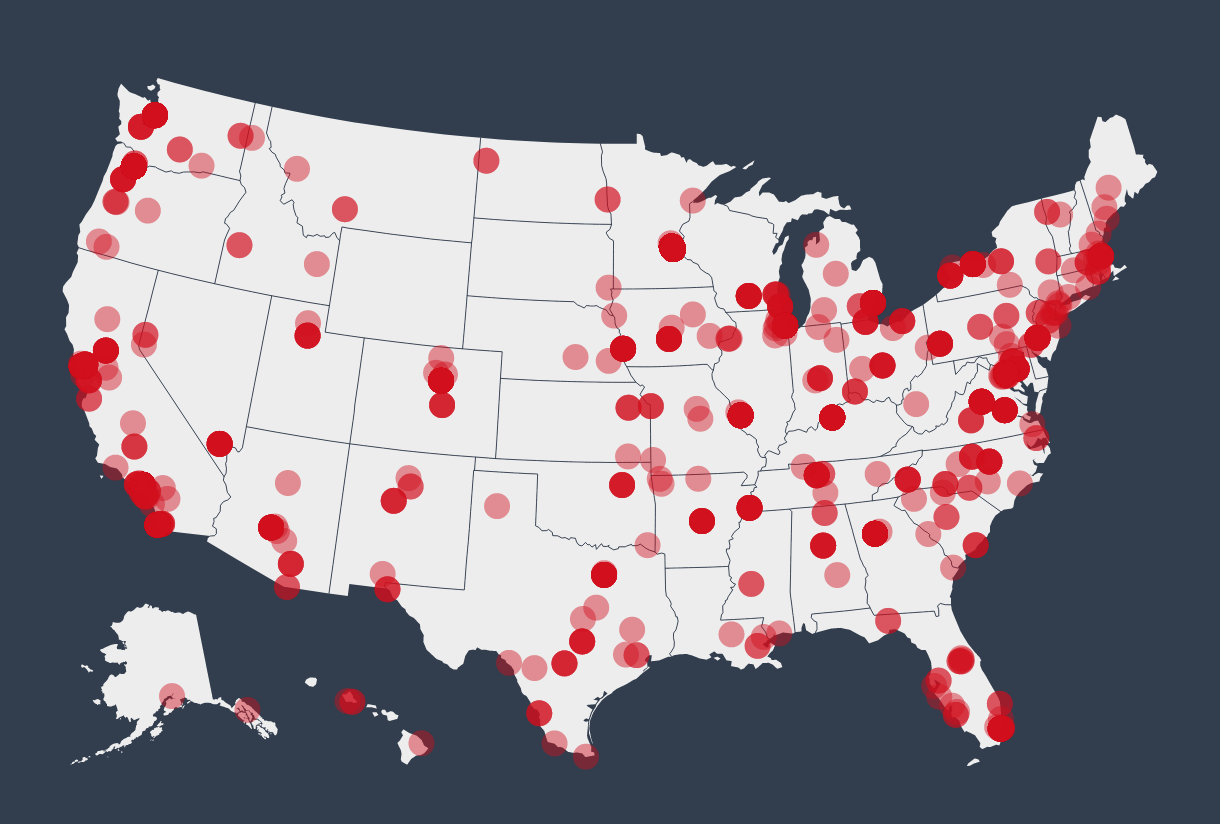
As this report documents, police have targeted journalists in other ways that have hindered their ability to do their jobs. They have denied journalists access to essential information or spaces where protests were taking place. Police sometimes claim that they can’t differentiate between journalists and protesters when everyone is carrying a cellphone, and in a few instances in recent years, violent protesters did try to pass themselves off as members of the press.12 But these isolated incidents must be placed alongside the many more documented instances in which police appeared to deliberately target journalists, even firing on them with rubber bullets and projectiles which in some cases caused serious injuries.13 Carolyn Cole eventually recovered, but other photojournalists have been permanently blinded.14
The First Amendment affords strong protections to protesters participating in public demonstrations, as well as to journalists covering them. It is vital to our democracy that police uphold these protections. The presence of the media is essential to dissent; it is the oxygen that gives protests life. Media coverage is one of the primary mechanisms by which protesters’ grievances and demands reach the broader public. By bringing incidents of mistreatment of protesters to public attention, media coverage also helps ensure that the authorities, including the police, are accountable to the public they serve. This coverage has frequently proven valuable in challenging official narratives from police or government officials about what took place at a protest. Police must do far more to ensure that officers respect and protect press freedom at protests, and they must hold accountable officers who fall short in this duty.
In most circumstances at a protest, the rights of journalists are the same as the rights of protest participants: All have the right to peacefully assemble, and to document events at the protest by recording and photographing. The First Amendment protects everyone’s right to record, not just that of professional journalists, and for good reason. There have been countless instances in recent years of bystanders recording footage that later became critically important to exposing government misconduct and sparking public debate about the actions of government officials.
It was a bystander, Darnella Frazier, who documented George Floyd’s murder.15 For those efforts, the Pulitzer Prizes awarded Frazier a special citation.16
There is one area in particular where journalists have been afforded distinct rights at protests: They are sometimes exempted from general curfews or orders to disperse. This was the case on May 30, 2020, when state troopers in Minnesota attacked Cole and other journalists.17 In these circumstances, it is infeasible for police to allow everyone who is photographing or recording events to remain at the scene, because the vast majority of protest participants have smartphones that could be used to engage in these activities. In this limited context, it makes sense for police to draw a distinction between protest participants and bystanders exercising their right to record at a protest, and journalists. Journalists’ primary purpose at a protest is to gather information to be shared with a broader audience and to serve as a public record of what occurred. Journalists must be present to observe the actions of the police, especially when the general public is barred from remaining in the area. It is precisely at the times when the right to assembly is being suppressed that the right to press freedom must be most scrupulously protected.
Minneapolis, MN
05-30-2020

Of course, this requires police to be able to distinguish journalists from other members of the public. How should police do this? In this report, we propose that police focus on what a person is doing at the protest. When an individual tells police they are a member of the press, police should look for observable evidence like the use of visible press credentials, professional camera equipment, or pen and paper for notetaking, the individual’s statements as to what media outlets they work with (or that they are freelance), or behavior, like interviewing protesters or observing the protest from a distance. Where there is doubt, police should adopt a “presumption of journalism” and assume that someone who appears to be engaged in journalism probably is. The adoption of such an approach requires that the police apply judgment, which means allowance must be made for errors made in good faith. Nonetheless, it would mark a significant step forward in obligating police to make a serious effort to protect journalists and ensure they are able to do their jobs at protests.
As this report makes clear, however, many of the most serious press freedom violations that have occurred in recent years do not stem from any difficulty on the part of the police in distinguishing who is and who is not a journalist. Especially since the civil rights protests in the 1950s and 1960s, police have in many cases directed violence toward journalists or targeted them for arrest, preventing them from fulfilling their constitutionally protected role. This report documents many such incidents in recent years, perhaps most notably the arrest of CNN reporter Omar Jimenez on live TV in 2020.18 As in the past, such high-profile abuses have spurred significant efforts to improve the legal environment for journalism, including through civil suits, legal reform, and new legislation. But such efforts at reform have been difficult to sustain, and the tools at hand are imperfect at best.
Minneapolis, MN
05-29-2020
These challenges exist even in times when the press is held in high regard and its rights are widely recognized and respected. But in recent years, public confidence in the media has reached an all-time low, and former President Trump’s and other officials’ consistent vitriol toward the press has further undermined the relationship between the media and a significant portion of the public.19 With attacks on journalists climbing, lawmakers and law enforcement officials must take further action to safeguard press freedom at protests and to hold police accountable when they deliberately interfere with press freedom or fail to ensure that journalists can work unimpeded.
The growing number of deliberate attacks on journalists also raises the worrying prospect that fewer journalists will be willing to cover protests in the future. Journalists know that their safety is never guaranteed when they are covering developing news stories like protests, but accepting the risks of accidental or incidental injury is a different proposition than the possibility that you will be singled out for mistreatment or arrest because of your work. Several of the journalists interviewed for this report expressed their wariness to continue covering protests due to the harsh treatment they have been subjected to, or have witnessed, at recent protests.
This report is based on dozens of interviews with journalists, researchers, and legal experts. In analyzing trends, we relied on data from the U.S. Press Freedom Tracker, whose history and methodology are described in a sidebar. To understand the police perspective, we reviewed court testimony, interviewed investigators, and contacted several police departments across the country. Most did not respond to our request for interviews; one agreed to share background information but declined to speak on the record. We also interviewed a former police official, who is quoted in Chapter 4. The lack of engagement from police was disappointing and indicative of the level of mistrust. Chapter 5 offers a practical approach to ensuring the rights of journalists, and the broader right to record at protests, are protected. Ensuring that media can cover protests freely and safely, particularly in instances where police deploy force, is necessary to the protection of the rights to assembly and speech that are enumerated in the First Amendment and are at the heart of American democracy.
Acknowledgments
This report was written by Joel Simon, a Knight First Amendment Institute senior research fellow. Chapter 2 was written by A. Adam Glenn; the sidebar on the First Amendment was written by Katy Glenn Bass. Research and fact-checking assistance came from Sarah Al-Shalash, Colin Cowperthwaite, Carrie DeCell, Anna Diakun, A. Adam Glenn, Lewit Gemeda, Sophia Henderson, Katerina Kaganovich, Soham Mehta, Anusha Merchant, Tolulope Sogade, Sam Subramanian, Victoria Tang, and Madeline Wood, with additional research courtesy of Stephanie Sugars from the U.S. Press Freedom Tracker. The report was edited by Elana Beiser, Anna Diakun, A. Adam Glenn, Katy Glenn Bass, Jameel Jaffer, Larry Siems, and Victoria Tang. The main illustration is by Dominic Bodden. The web layout was designed by Pooj Padmaraj with production assistance from Isabel Adler, Lorraine Kenny, and Candace White.
The report recommendations were drafted by the Knight First Amendment Institute based on the research findings. They present a roadmap for addressing an urgent challenge at the heart of American democracy. In order to guarantee the First Amendment rights of all Americans who participate in demonstrations, journalists covering their activities must be able to perform their job freely and safely.
Footnotes
-
1.
Interview with Carolyn Cole, Staff Photographer, L.A. Times (Nov. 8, 2022); Carolyn Cole: Staff Photographer, L.A. Times, https://www.latimes.com/people/carolyn-cole [https://perma.cc/AW9J-2QKB] (last visited Mar. 8, 2023).
-
2.
Interview with Carolyn Cole, Staff Photographer, L.A. Times (Nov. 8, 2022).
-
3.
Id.; Wendy Lee, L.A. Times Journalists Sue Minnesota State Troopers Over Attack, L.A. Times (May 27, 2021, 10:52 AM), https://www.latimes.com/entertainment-arts/business/story/2021-05-27/los-angeles-times-journalists-sue-minnesota-state-patrol-floyd-protests [https://perma.cc/D7TC-6H42]; Complaint and Demand for Jury Trial, Cole v. Does, No. 0:21-cv-01282 (PJS/JFD) (D. Minn. May 25, 2021).
-
4.
Larry Buchanan et al., Black Lives Matter May Be the Largest Movement in U.S. History, N.Y. Times (July 3, 2020), https://www.nytimes.com/interactive/2020/07/03/us/george-floyd-protests-crowd-size.html [https://perma.cc/SYA6-XVNE].
-
5.
Kelsey Vlamis, More Than 100 Journalists Were Arrested or Detained While on the Job in the US This Year — A More Than 1,200% Increase from the Year Before, New Report Says. Insider (Dec. 17, 2020, 1:04 AM), https://www.insider.com/117-journalists-arrested-or-detained-on-the-job-in-us-2020-12 [https://perma.cc/T38Y-X6Q8]; Wendy Lee, L.A. Times Journalists Sue Minnesota State Troopers Over Attack., L.A. Times (May 27, 2021, 10:52 AM), https://www.latimes.com/entertainment-arts/business/story/2021-05-27/los-angeles-times-journalists-sue-minnesota-state-patrol-floyd-protests [https://perma.cc/HF6J-DJQ3].
-
6.
Sarah Matthews et al., Press Freedoms in the United States 2020: A Review of the U.S. Press Freedom Tracker (2021), https://www.rcfp.org/wp-content/uploads/2021/05/Press-Freedom-Tracker-2020_FINAL.pdf [https://perma.cc/H9VC-B4BR].
-
7.
Id.
-
8.
Tom Jones, Attacks on Media Covering the Protests are Simply Following the President’s Rhetoric, Poynter (June 1, 2020), https://www.poynter.org/newsletters/2020/attacks-on-media-covering-the-protests-are-simply-following-the-presidents-rhetoric/ [https://perma.cc/D9L3-3PLC].
-
9.
Sarah Matthews et al., Press Freedoms in the United States 2020: A Review of the U.S. Press Freedom Tracker (2021), https://www.rcfp.org/wp-content/uploads/2021/05/Press-Freedom-Tracker-2020_FINAL.pdf [https://perma.cc/H9VC-B4BR].
-
10.
Carmela Caruso, US Journalists Covering Protests at Risk of Arrest, VOA News (Dec. 14, 2021, 4:15 PM), https://www.voanews.com/a/us-journalists-covering-protests-at-risk-of-arrest-/6354930.html [https://perma.cc/DC36-TBUC].
-
11.
Id.
-
12.
See infra Chapter 5.
-
13.
Sarah Matthews et al., Press Freedoms in the United States 2020: A Review of the U.S. Press Freedom Tracker (2021), https://www.rcfp.org/wp-content/uploads/2021/05/Press-Freedom-Tracker-2020_FINAL.pdf [https://perma.cc/H9VC-B4BR].
-
14.
Interview with Carolyn Cole, Staff Photographer, L.A. Times (Nov. 8, 2022); Wil Sands, The Shot-in-the-Eye Squad, Pulitzer Ctr. (May 21, 2021), https://pulitzercenter.org/stories/shot-eye-squad [https://perma.cc/D74G-JGQT].
-
15.
Giulia McDonnell Nieto del Rio, Darnella Frazier, the Teenager Who Recorded George Floyd’s Murder, Speaks Out, N.Y. Times (July 7, 2021), https://www.nytimes.com/2021/05/25/us/darnella-frazier.html [https://perma.cc/J7F5-Y4BG].
-
16.
The 2021 Pulitzer Prize Winner in Special Citations and Awards, The Pulitzer Prizes, https://www.pulitzer.org/winners/darnella-frazier [https://perma.cc/PC95-6XJ5] (last visited May 26, 2023).
-
17.
Wendy Lee, L.A. Times Journalists Sue Minnesota State Troopers Over Attack, L.A. Times (May 27, 2021, 10:52 AM), https://www.latimes.com/entertainment-arts/business/story/2021-05-27/los-angeles-times-journalists-sue-minnesota-state-patrol-floyd-protests [https://perma.cc/D7TC-6H42]; Complaint and Demand for Jury Trial, Cole v. Does, No. 0:21-cv-01282 (PJS/JFD) (D. Minn. May 25, 2021).
-
18.
Jason Hanna & Amir Vera, CNN Crew Released from Police Custody After They Were Arrested Live on Air in Minneapolis, CNN (May 29, 2020, 8:19 PM), https://www.cnn.com/2020/05/29/us/minneapolis-cnn-crew-arrested/index.html. [https://perma.cc/5K4K-6UKA].
-
19.
Megan Brenan, Americans’ Trust in Media Remains Near Record Low, Gallup (Oct. 18, 2022), https://news.gallup.com/poll/403166/americans-trust-media-remains-near-record-low.aspx [https://perma.cc/JWG5-6BEL]; Jeffrey Gottfried, et al., Trusting the News Media in the Trump Era, Pew Research Center (Dec. 12, 2019), https://www.pewresearch.org/journalism/2019/12/12/trusting-the-news-media-in-the-trump-era/ [https://perma.cc/64RG-37X8].